Losing fat and building or preserving muscle at the same time is possible — but it requires clear priorities, disciplined nutrition, and a smart training plan. This guide gives you practical, science-informed strategies, sample weekly templates, and subtle, responsible options for natural testosterone support as an adjunct to your program.
Contents
- 1 Why recomposition feels impossible (and when it’s realistic)
- 2 The science in plain language
- 3 Four practical approaches — choose one based on your level and priority
- 4 Training essentials (so muscle is actually built and preserved)
- 5 Nutrition rules that actually matter
- 6 Recovery, sleep, and daily activity
- 7 Smart supplementation (support, not shortcuts)
- 8 About natural testosterone support
- 9 Two sample weekly templates
- 10 How to track progress (meaningful metrics)
- 11 Common mistakes and fixes
- 12 Final takeaway (short)
Why recomposition feels impossible (and when it’s realistic)
At the metabolic level, muscle growth (anabolism) and fat loss (catabolism) pull in different directions: muscle building is easiest with a calorie surplus, while fat loss requires a calorie deficit. That said, body recomposition — losing fat while maintaining or even adding muscle — is realistic for:
- Beginners and people returning after a layoff (rapid strength and neuromuscular gains).
- Individuals who have room to increase protein and training quality.
- People who manage calories, protein, and training precisely.
For intermediate and advanced trainees, recomposition is slower and often better managed by alternating phases (modest bulk → lean down) instead of expecting dramatic simultaneous results.
Quick overview — what to expect
- Beginners: recomposition is likely; progress can be relatively quick.
- Intermediate/advanced: faster progress comes from split phases (lean bulk then cut).
- Always: prioritize protein, heavy resistance training, sleep, and recovery.
The science in plain language
- Muscle growth requires: mechanical tension (resistance training), adequate protein, and energy for synthesis.
- Fat loss requires: a sustained calorie deficit.
- Hormones matter: testosterone, insulin sensitivity, and growth factors influence how readily you gain or preserve muscle. Lifestyle choices (sleep, stress, body fat percentage) strongly affect hormonal balance.
You can preserve muscle while in a small deficit by maximizing training quality, protein intake, and recovery; building substantial new muscle is usually easier in a mild surplus.
Four practical approaches — choose one based on your level and priority
1. Recomposition approach (best for beginners/returns)
This method is perfect if you’re new to strength training or getting back into it after a break. The goal is simple: lose fat while building or maintaining muscle — without going on a harsh diet.
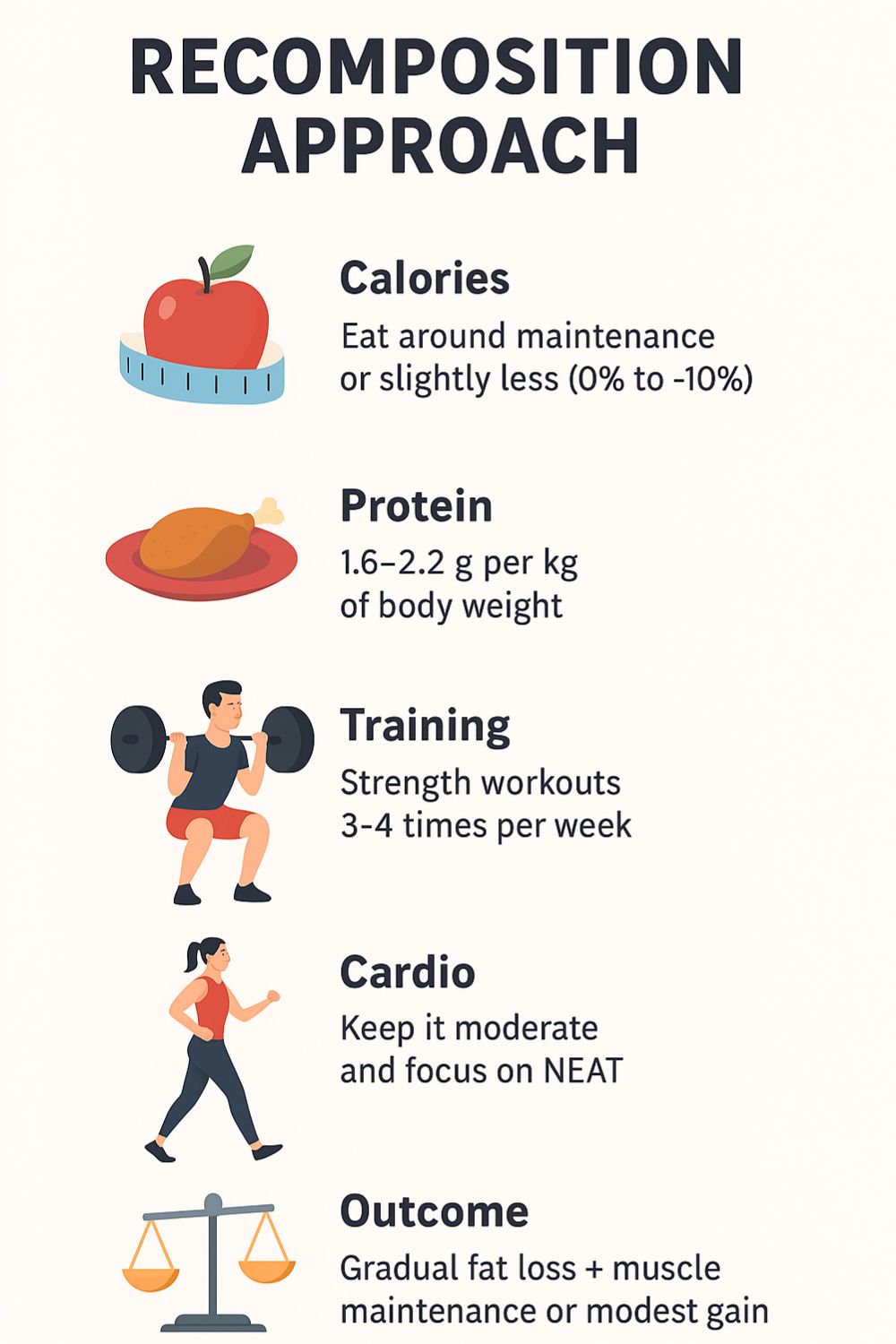
🍽️ Calories: Eat Around Maintenance or Slightly Less (0% to –10%)
You don’t have to starve yourself.
Eat roughly the number of calories your body needs to maintain its current weight — or just a little less (about 10% lower).
That small deficit gives your body enough fuel to build muscle while still burning some fat.
👉 Example:
If your maintenance calories are 2,500 per day, aim for around 2,250 calories instead.
💡 Tip: Use a calorie tracker app (like MyFitnessPal) for a week to learn what maintenance looks like for you.
🍗 Protein: 1.6–2.2 g per kg of Body Weight
Protein is the key to muscle repair and growth.
Aim for 1.6–2.2 grams of protein per kilogram of body weight each day.
👉 Example:
If you weigh 70 kg (155 lbs), eat 110–155 grams of protein daily.
💡 Easy ways to hit your protein goal:
- Include a protein source at every meal (chicken, fish, eggs, Greek yogurt, tofu).
- Use a protein shake if you’re short on time or appetite.
- Spread your protein evenly throughout the day.
🏋️♀️ Training: Strength Workouts 3–4 Times Per Week
Focus on compound exercises (like squats, deadlifts, presses, and rows) — they work multiple muscles at once.
If you can train 3 days per week:
→ Do full-body workouts each session.
If you can train 4 days per week:
→ Try an upper/lower split, alternating between upper and lower body days.
💡 Progressive overload:
Try to lift a little heavier, do more reps, or improve your form every week — that’s how you keep progressing.
🚶♂️ Cardio: Keep It Moderate and Focus on Movement
You don’t need to do endless cardio.
Just aim for moderate cardio a few times per week (like brisk walking, cycling, or jogging).
Even more important is NEAT (Non-Exercise Activity Thermogenesis) — the calories you burn just by moving around during the day.
💡 Simple ways to increase NEAT:
- Take the stairs instead of the elevator
- Walk or stand during phone calls
- Get 8,000–10,000 steps per day
These small habits add up and help with fat loss without extra gym time.
⚖️ Outcome: Slow but Sustainable Progress
This approach gives steady, realistic results — you’ll lose fat slowly while maintaining or even gaining muscle.
You might not see huge scale changes right away, but your body will look and feel leaner, stronger, and tighter over time.
💡 Remember:
Consistency matters more than perfection. Stick with it for 8–12 weeks and track your progress with photos, not just the scale.
2. Phased approach (bulk → cut or cut → bulk; best for intermediates)
This method splits your fitness journey into two clear phases — one for building muscle (bulking) and one for losing fat (cutting).
You focus on one goal at a time, instead of trying to do both at once.
It’s a great way to make visible, steady progress without feeling stuck in the middle.
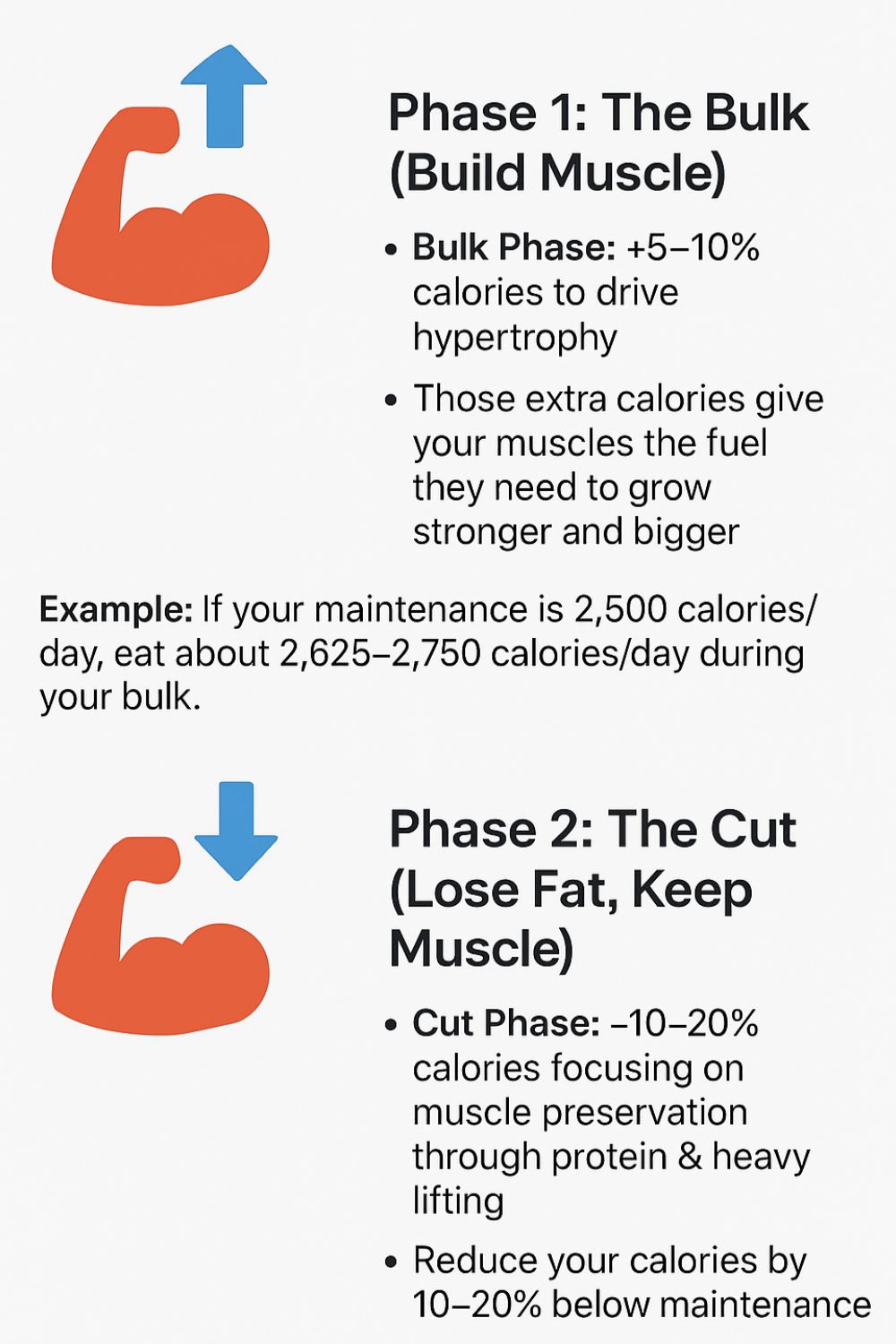
🍽️ Phase 1: The Bulk (Build Muscle)
During this phase, you’ll eat slightly more calories than your body burns — around +5–10% above maintenance.
Those extra calories give your muscles the fuel they need to grow stronger and bigger.
👉 Example:
If your maintenance is 2,500 calories/day, eat about 2,625–2,750 calories/day during your bulk.
💡 Tips for a clean bulk:
- Prioritize protein (1.6–2.2 g per kg of bodyweight).
- Keep carbs moderate to support workouts.
- Don’t use it as an excuse to eat junk — focus on whole foods like rice, oats, chicken, eggs, and vegetables.
🏋️ Training Focus:
Lift heavy and focus on progressive overload — increasing weights or reps over time.
Goal: Build lean muscle with minimal fat gain.
⚖️ Phase 2: The Cut (Lose Fat, Keep Muscle)
After your bulk phase (usually 8–12 weeks or longer), switch to a cut phase to shed fat while holding onto your hard-earned muscle.
Reduce your calories by 10–20% below maintenance — enough to lose fat steadily, but not so much that you feel weak.
👉 Example:
If your maintenance is 2,500 calories/day, eat about 2,000–2,250 calories/day during your cut.
💡 Tips for cutting effectively:
- Keep protein high (same as bulking).
- Lift heavy — don’t switch to light weights! Your muscles need a reason to stay.
- Add some cardio (2–3 times a week) for fat loss and heart health.
Goal: Lose fat while maintaining muscle shape and strength.
🔁 Why It Works: “Sawtooth” Progress
Over time, this approach looks like a sawtooth pattern —
you go up slightly in weight during bulking (muscle gain), then come down during cutting (fat loss).
Each cycle makes you leaner, stronger, and more muscular than before — a controlled, repeatable process that avoids yo-yo dieting.
🧠 Bonus Tips
- Spend more time bulking than cutting — muscle takes longer to build than fat to lose.
- Take photos and measurements — your appearance matters more than the number on the scale.
- Support your recovery and hormone health naturally — consider supplements that help balance energy and testosterone levels.
3. Bracketed-carb / training-focused nutrition
This method helps you balance energy and fat loss by adjusting how many carbs you eat based on your training days. It’s great for people who want to stay strong in the gym but still lose fat over time.
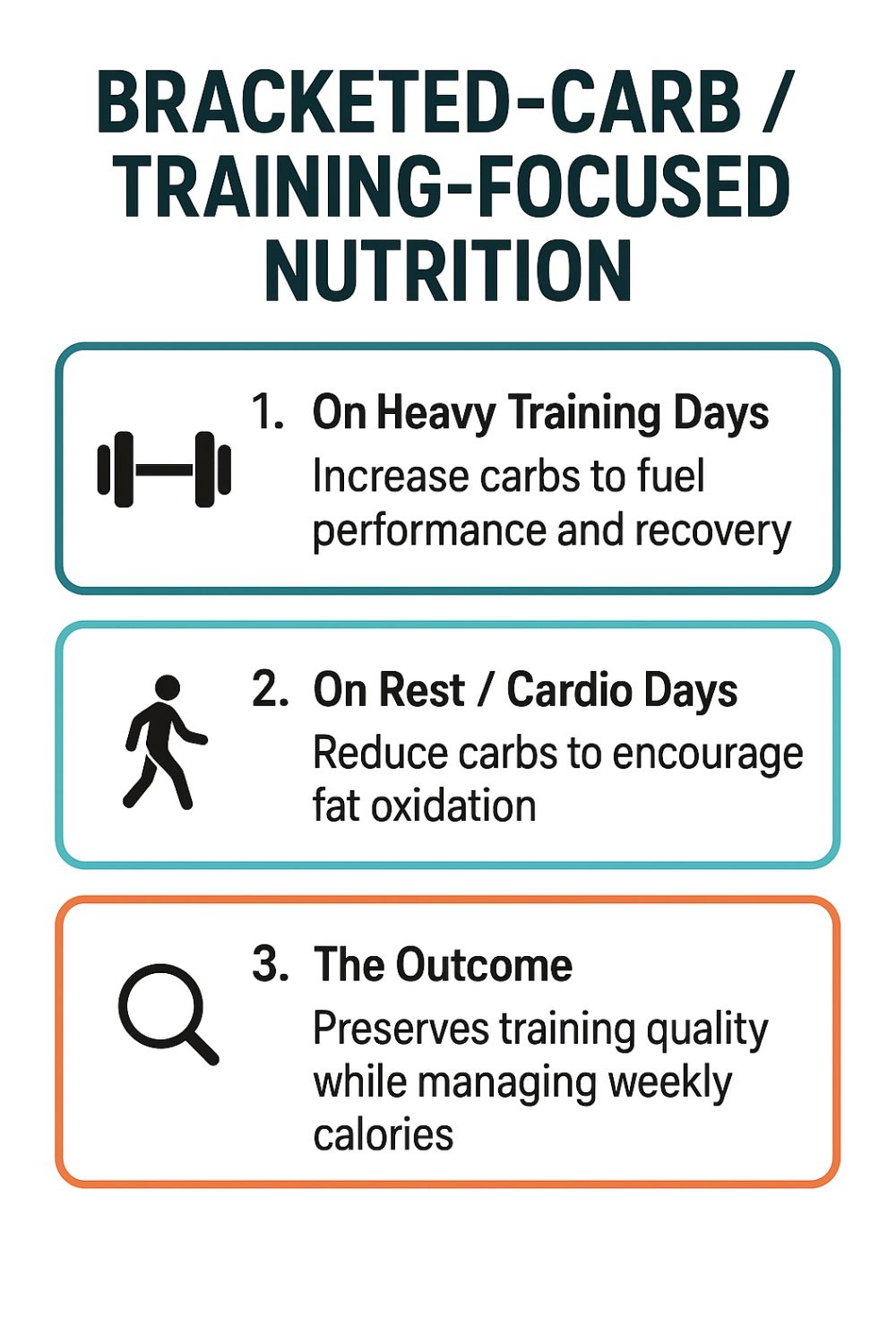
💪 On Heavy Training Days (e.g., when you lift weights or train hard)
- Eat more carbs around your workout — before and after.
Example: oatmeal or fruit before your workout, rice or potatoes after. - Keep protein high (chicken, eggs, fish, protein shake).
- Keep fats moderate (olive oil, nuts, avocado).
- Why: The extra carbs help you lift heavier, recover faster, and protect your muscles.
🚶 On Rest or Cardio Days
- Reduce carbs — no need for as much energy.
Example: skip rice or bread, have more veggies instead. - Keep protein the same to maintain muscle.
- You can increase healthy fats a little to stay full.
- Why: Lower carbs on these days help your body burn stored fat for energy.
🔁 The Big Picture
- You’re not eating the same every day — you’re cycling carbs depending on what your body needs.
- Over time, this helps you stay lean, perform well, and build muscle without gaining fat
4. Fat-loss priority (when you need to lean down fast)
his plan is for when your main goal is to lose fat quickly — maybe for an event, a photoshoot, or just to feel lighter and tighter. The key is to keep your calorie intake low without losing your hard-earned muscle.
🍽️ Calories: Create a Deficit
- Eat 15–25% fewer calories than your body needs to maintain weight.
Example: If you maintain at 2,400 calories, eat around 1,800–2,000 daily. - Avoid cutting more than this — going too low can slow your metabolism and make you lose muscle.
🥩 Protein: Keep It High
- Protein is your best friend here!
- Aim for 1.6–2.2 grams per kilogram of body weight daily.
(Example: If you weigh 70 kg, eat 110–150 g protein daily.) - This helps protect your muscles while burning fat.
🏋️ Training: Keep Lifting Heavy
- Don’t stop strength training!
- Focus on keeping the same intensity (heavy weights, good form), even if you do fewer sets.
- Your goal is to tell your body to keep the muscle while it burns fat.
🏃 Cardio: Add, Don’t Overdo
- Include moderate cardio (like brisk walking or cycling) 3–4 times per week.
- Avoid going overboard — too much cardio can make you tired and affect your lifting performance.
⚖️The Outcome
- You’ll notice faster fat loss — usually visible after 2–4 weeks.
- You might lose a little strength or energy if your deficit is deep, but protein and smart training minimize that risk.
- This phase works best for short-term fat loss, then transition back to maintenance or muscle building.
Training essentials (so muscle is actually built and preserved)
- Progressive overload: systematically increase load, reps, or sets.
- Compound lifts first: squats, deadlifts, presses, rows for maximal stimulus.
- Rep ranges: blend strength (4–6) and hypertrophy (8–15).
- Volume: aim for ~8–20 hard sets per major muscle group per week depending on experience.
- Frequency: work each muscle group 2–4 times weekly for most trainees.
Nutrition rules that actually matter
- Protein: 1.6–2.2 g/kg/day (0.73–1.0 g/lb). Critical for muscle preservation in a deficit.
- Calories: calculate maintenance, then choose a sensible deficit (10–20%) for fat loss or a small surplus (5–10%) for lean gains.
- Fats: 20–30% of calories to support hormones.
- Carbs: time them around training to improve performance and recovery.
- Micronutrients & hydration: adequate vitamins, minerals, and water are non-negotiable for recovery and performance.
Recovery, sleep, and daily activity
- Sleep: 7–9 hours/night; poor sleep undermines recovery and hormone balance.
- Stress management: chronic stress elevates cortisol and can hinder progress.
- NEAT: daily non-exercise activity (walking, standing, light chores) is a potent driver of calorie expenditure.
Smart supplementation (support, not shortcuts)
Use supplements to complement a solid program — not replace it.
- Protein powder: convenient to hit targets.
- Creatine monohydrate: proven for strength and muscle gains.
- Vitamin D & Omega-3s: support general health, especially if deficient.
- Caffeine: improves workout performance and can support fat oxidation.
About natural testosterone support
Healthy testosterone levels support muscle growth and recovery. First-line strategies include sleep, reducing body fat, resistance training, and proper nutrition. Some natural supplements (e.g., vitamin D if deficient, zinc, magnesium blends) are marketed to support testosterone levels and overall energy. These can be considered supportive — not curative — and are most effective when paired with a solid lifestyle and training program.
Explore natural testosterone support →
Note: If you suspect clinically low testosterone, consult a medical professional for testing and guidance.
Two sample weekly templates
A) Recomposition (4 days — beginner-friendly)
- Mon: Full-body strength (heavy)
- Tue: Light cardio + mobility
- Wed: Full-body hypertrophy (moderate reps)
- Thu: Rest or active recovery
- Fri: Full-body strength (progressive overload)
- Sat: Optional low-intensity cardio / NEAT
- Sun: Rest
B) Fat-loss priority (4–5 days)
- Mon: Whole-body strength
- Tue: Cardio (intervals or steady-state)
- Wed: Rest or mobility
- Thu: Whole-body strength
- Fri: Cardio
- Sat: Optional accessory work or long walk
- Sun: Rest
How to track progress (meaningful metrics)
- Primary: weekly bodyweight trend, monthly progress photos, and strength in key lifts.
- Secondary: circumference measurements (waist, chest), how clothes fit, energy, and recovery.
Avoid overreacting to daily scale fluctuations; focus on multi-week trends.
Common mistakes and fixes
- Mistake: cutting calories too aggressively → Fix: use a smaller deficit and keep protein high.
- Mistake: stopping resistance training during a cut → Fix: prioritize heavy lifts to preserve muscle.
- Mistake: expecting quick recomposition as an experienced trainee → Fix: plan phased blocks and set realistic timelines.
- Mistake: relying solely on supplements → Fix: prioritize training, nutrition, sleep first.
Final takeaway (short)
Recomposition is achievable with clear priorities: maximize protein and training quality, manage calories sensibly, improve sleep and recovery, and use evidence-based supplements as support. If you’re intermediate or advanced, accept that the fastest path to muscle growth often requires phased bulks and cuts — but small, consistent wins add up.
Well this could likely be considered a very good article, instead beneficial an I be conscious that it is in real truth instead crucial particularly for people teenagers who’ve dermis problems.